Sometimes when I read a headline, such as this one, I’ll instantly see what’s wrong with it and chuckle.
Other times, however, I’ll read it and think hang on, something doesn’t seem quite right here, and it’ll take me a second before I latch on to what’s wrong about it.
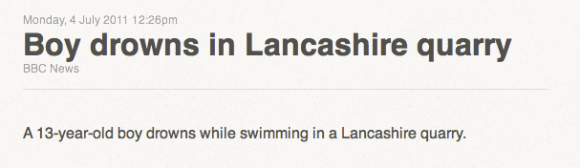
Take this headline, for instance. Take a closer look at the sub-heading.
Yes, I know I’m being pedantic with this one. But when I looked at this I thought, surely if he was swimming he would’t have drowned, would he? A more correct subheadline would be “Boy drowns while failing to swim in a quarry”.
This is the sort of stuff I think about all the time.
We have what can only really be described as bible boasters coming down my way next week for a week-long conference. A whole week on biblical literature. Sounds about as exciting as watching the X-Factor whilst listening to paint dry. Which, I suppose, is better than watching paint dry whilst listening to the X-Factor.
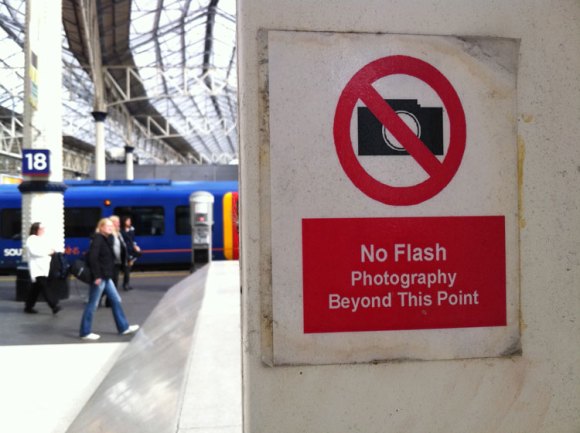
Still, I have found the perfect lapel pin to wear for the week to let people know how I feel:
Yes yes, I know this looks like a news post. But it isn’t.
Turns out a coroner has stated that the turning off of a speed camera played a major role in the death of a 19-year-old in Somerset. From the BBC News article:
A Somerset coroner has said the turning off of a speed camera was a significant factor in a fatal car crash.
In a letter to the county council, West Somerset coroner Michael Rose said the death of 19-year-old Billy Davis “in part may have been prevented”.
Mr Davis died on the A370 at East Brent in September 2010 near a camera which had been disabled weeks earlier.
Now, any regulars to this blog will know that I am not all that keen on speed cameras. Maybe some of you are thinking that I may be about to rescind my previous comments and agree that yes, speed cameras can save lives.
But take a look at the paragraph that follows that quote above.
An inquest found Mr Davis had been one-and-a-half times over the drink-drive limit when he died and had been driving at speeds between 60mph to 70mph in a 40mph area.
Right. So what we appear to be claiming now is that speed cameras can detect drunk drivers or that an intoxicated driver will be able to slow down and react safely when he unexpectedly comes across a speed camera.
It is far more likely that a speed camera would have expedited the death of the chap in question. A drunk driver slamming on the breaks would lose control and is more likely crash into the camera than be saved by it.
It’s an increasing problem that no-one in this country seems to want to take responsibility for their own actions. It is really rather worrying however when a coroner of all people seems to think that the blame for an accident lies with the as much with the lack of a speed camera as with a drunk driver going at almost twice the speed limit.
I realised today what Microsoft’s main problem is. Simply enough, they don’t think things through properly. If it seems like a good idea at first they’ll run with it, and no-one will to have the courage to pipe up and say ‘hang on lads, is this really such a good plan?’ until after it’s too late. Take their purchase of Skype, for instance. Is there anyone besides Steve Ballmer who thinks that Skype is worth $8.7b? Or the Kin phones, cancelled only six weeks after they were launched.
The Kinect too. It may be doing rather well, but as a gaming tool it is cripplingly ineffective compared to a good old-fashioned controller and the sort of games that are coming out are awkwardly twisted around this control interface. Impressive it may be, practical it isn’t. Or, for instance, the Windows 7 FAQ. I took a look today trying to find out the system requirements for Windows 7 for work. One of the questions caught my eye.
Wow. So in order to find out what version of Windows you are running on your PC, you have to already know what version of Windows you are running. Fantastic logic, and a worrying sign of what to expect from Microsoft’s tech support. You’ll be on the phone for ages with the same cyclic argument. A little further down, the section about drivers seems to be getting increasingly panicked:
It’s almost as if this is a transcript of an actual support call, where it is becoming increasingly apparent to the caller that they don’t know as much about computers as they thought they could get away with. Knowing this planet however, that caller is probably an IT manager somewhere.
The BBC, as a publicly-funded organisation, is often being called upon to save money. Star salaries need to be cut, people say. The corporation needs to be more prudent with its money.
To my recollection, there are two things I can think of that have happened as a direct result of the BBC trying to save money. Depending on who you are and what you like, you may not care about either of them. But I’m sure some will.
Firstly, and most recently, the BBC is selling off its iconic Television Centre. The home of the Blue Peter Garden – where countless childhood companions are no doubt buried, like Petra, Bonnie and the original John Noakes – is being sold off to raise – and save – money for the BBC. The site is to be redeveloped into we don’t know what yet, although due to the fact big bits of the Centre are grade listed, whatever results is going to look a bit bizarre.
It is a great shame. There are few as iconic buildings in the media anywhere, and it is in many ways part of our national heritage. Many of us growing up with Saturday TV will be familiar with TV Centre, from the opening titles of Live and Kicking in the morning or Noel’s House Party in the evening.
The Beeb are moving to far less iconic buildings up in Salford, whilst BBC News is moving over to the almost-as-iconic Broadcasting House (although for some reason, BBC Breakfast – ostensibly a BBC News broadcast – is moving up to Salford too, with a splitting up of the presenting team that help many of us to get to work in the mornings).
I don’t like it, but I guess for a corporation funded by public money, there’s not much that can be done when people start calling for efficiency savings. But I’m glad to say I have been to Television Centre for a handful of TV tapings, and I’ll probably get on one of the official studio tours before they pack it all off to Greater Manchester.
The second problem that has resulted from the Beeb trying to save money is less recent, but is probably far, far worse. As recently as the early nineties the BBC (as well as other broadcasters) would routinely wipe tapes of broadcasts in order to reuse tapes or save space in what were, back then, physical archives.
108 episodes of Doctor Who. Destroyed to save a bit of money. License fee payers and BBC management have done more to the Doctor than the Daleks, Cybermen and Russell T Davies combined.
Not with my license fee
That’s one complaint you always seem to hear on those vox pops on the news when it emerges the BBC has spent x amount of money on something that wasn’t a programme they enjoy, like Jonathan Ross’s £18m salary or the rumoured £147,000 cost of a single episode of Top Gear.
Of course, any sensible person will tell you, the annual license fee costs £145. Which means if you watch even a small part of a single episode of something on the BBC, be it the news, a soap or a documentary, you’ve already technically gotten your license fee’s worth.
The Beeb have been kind enough to break down their expenditures, showing where your month’s worth of license fee goes. Long story short, two thirds of it goes on TV productions (which may or may not include big salaries like the one Jonathan Ross got, I don’t know). That’s £7.85. £7.85 of your license fee in a month goes on TV. That won’t even cover the first tape, let alone any of the cameras, explosions, or special effects you find in many productions.
There’s more to it than that, too. Shows such as Top Gear and Doctor Who are really rather lucrative for the BBC in terms of merchandising, licensing and selling the show overseas. They could, in real terms, even be paying for themselves. So whether you watch these shows or not (although you should, they are the best shows the Beeb has), it doesn’t really matter because they probably don’t cost much to the license fee payer.
I do also hate people who dislike, say, Top Gear because they take offence to its content, and complain about their license fee being spent on it, but then turn around and watch something I truly can’t stand like Songs of Praise without batting an eyelid. That, however, is fodder for a separate rant about how everyone is self-absorbed into their own problems and don’t care about other people. As is the argument that Top Gear is as much a pro-oil pamphlet as Songs of Praise is a pro-religion one.
That way I look at it is this: my £145 a year pays for the TV I like. Yours pays for the TV you like. And the BBC is a national institution that is extremely rare in the world, and we should be fighting to protect it. In fact, on that front I’ll get Mitch Benn to play out this post:
Barely a month goes by where we don’t see a story in the media about how daffodils are blooming earlier or fruits are ripening sooner because of atypical weather. It happens every year. Sometimes it’s in spring, sometimes it’s in summer, sometimes it’s even in winter, but the gist is the same whenever the story is posted: climate change is confusing mother nature.
Take a story from today’s Metro, for instance:
Dry spring, hot summer, mild winters. We hear it all the time. What people seem to forget is this: it’s still here. The biodiversity of this planet has suffered through much over the last few billion years, but it always struggles on. Sure, there has been a massive turnover of species over the years, but life in general will usually carry on regardless.
I guess I generally don’t worry much when the media churn out the same old scare stories.
I’m sure that BBC News assign the headlines for their RSS feed to a junior writer or work experience kid. The RSS headlines are often far more informal or ambivalently worded than the headline on the actual article.
Today, I couldn’t help but notice this one:
All I thought was ‘wow, that crash must have really upset him’.
One of the nice background features of the software that powers this blog is the ability to see a variety of stats for site visits. I can see the number of visitors, what posts have been viewed, the other webpages people were on when they followed a link to this site (in other words, mainly Facebook) and search engine terms that have directed people to this site.
I check this stats page periodically to satisfy my curiosity. Sometimes, however, the page only serves to pique that curiosity.
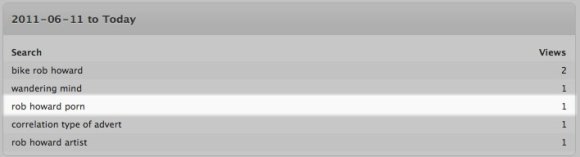
For instance, here is the Google search terms that have apparently brought people to this site over the last seven days:
Ignore for a moment the slightly depressingly low view counts, and take a closer look at the terms that led people here. See anything?
Let’s highlight the part in question if you’re having trouble.
Right. Now who the heck was looking for that? And why the heck would you want to?








 My Blog Thing